Todd Hawbaker’s passion for journaling led to an unexpected hobby — pen making — that has grown into a successful part-time business, Ink & Timber Pens. Nothing in his background predicted his new vocation.
Born and raised in State College, he majored in philosophy at Penn State, worked for his father in property management, and now manages the furniture recycling program for Interfaith Human Services.
“This is my first creative venture, being a craftsman,” Hawbaker says. “This certainly wasn’t what I thought I would do — going to these shows, putting up a tent at [the Central Pennsylvania Festival of the Arts], and selling things. It’s kind of a dream come true.
“I think I just happened on it. It’s a hobby that other people do. I had a lathe. I got some pen parts and made a wooden pen. And I thought it was cool.”
Hawbaker thinks what drew him in was being a journaler. “I like to do personal writing where I just sit and write.”
In 2020, he began his craftsman journey by making ballpoint and rollerball pens from various woods, with some metal parts, in his workshop in Waddle and gave them to friends and coworkers. He also began making pen barrels from a hand-poured, two-part epoxy resin, embedding strips of iridescent abalone seashells or adding dyes and sparkly mica powders to create colorful swirling patterns.
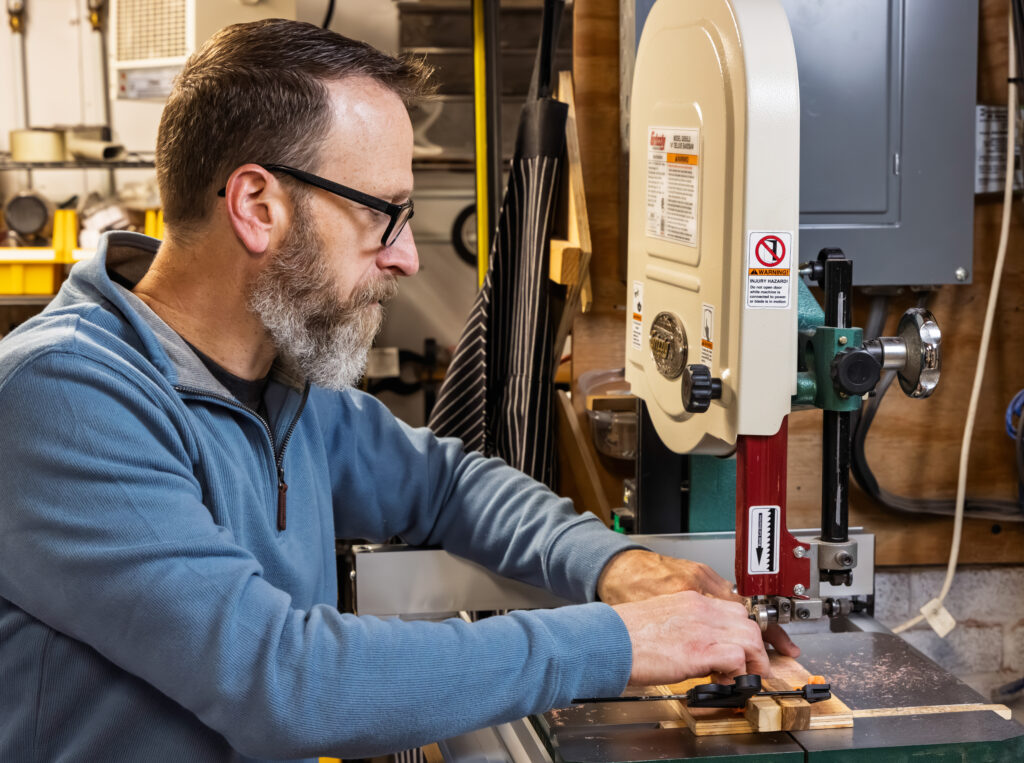
After cutting the wood or resin blocks to size, he uses a lathe to shape them into pen barrels, drilling out the centers to the exact opening needed for the brass tubes he inserts to provide structural integrity. To check the opening size, he measures to one one-thousandth of an inch with a micrometer.
“Making pens is precision work,” Hawbaker says.
After applying 10 coats of glossy cyanoacrylate finish to the pen barrels, he polishes the finished pens with a 10-step process using a polishing wheel and white diamond polishing compound, then a sequence of nine very fine sandpaper grits, from 1,500 to 12,000, to create a mirror finish.
Hawbaker chooses woods he finds interesting from different continents. Two examples from South America are cocobolo, a dark brown rosewood with vibrant orange streaks, and bocote, which smells like dill pickles when cut.
“I’m always trying to find something dramatic.”
He also makes custom pens from woods that are meaningful to the customers, such as an apple tree branch from their parent’s yard.
“Those are the best projects,” he says. “You can’t beat that for feeling connected to a handmade item.”
To obtain more colors, he dyes some woods. For the most complex pens, he creates scalloped patterns that look like inlays by assembling multiple wood or colored resin pieces together into larger blocks and cutting them diagonally to produce the desired curved lines for the pen barrels. He places metal or resin separators between the pieces to create delicate metallic or colored lines.
A single barrel pen takes him 1 1/2 total hours to make, and the scalloped pens take six hours.
At the suggestion of his wife, he started making seam rippers for sewing, with handles of colored and metallic threads wrapped around the brass cylinder, embedded in clear resin.
During the early days of his penmaking, his father asked him to make a fountain pen for a friend who really liked the old-fashioned type of instrument.
Hawbaker made one for his father’s friend and one for himself, but wondered why anyone would want a fountain pen when ballpoint pens were so convenient, with ink that lasted so long.
“And then I tried writing with a fountain pen. I was like — oh, I get it now. Three scribbles in, it’s just a different writing experience. I feel like I slow down and my handwriting gets a little neater, because I’m paying more attention. To me, it’s an enhancement of the writing experience. … It helps me to slow down and collect my thoughts and work through some things and get clarity.”
Hawbaker notes that bottles of fountain pen ink are available in thousands of colors.
He gave one friend a fountain pen and journal, and 10 days later, the friend texted him to ask how to fill the pen with ink.
“I thought, he’s actually using it.”
He ran out of friends to give pens to but didn’t want to stop making them. The next logical step was to set up a booth at craft shows. Four years ago, he was accepted into his first show, the Bellefonte Arts & Crafts Fair, and sold some pens. Each year he was able to get into larger shows: Way Fruit Farm, People’s Choice Festival, then more than half a dozen shows in 2025, including the Central PA Festival of the Arts in State College.
“I did really well there. … It was definitely fun. I like talking about pens. … I sell a lot of fountain pens to young men in their 20s.
“As a guy who journals and feels that I get a lot of benefit out of it, thinking that somebody else started to journal with my pen is just fantastic.”
His next show is the Artist’s Winter Market on Dec. 5-6 at the Gallery Shop and Art Alliance in Lemont. His Ink & Timber Pens are available at the Gallery Shop all year.
For more information, visit inkandtimberpens.com. T&G
Karen Dabney is a freelance writer in State College.